



How Online Payments Behave in Holiday Season: Merchant Guide
In this article:
- Peak traffic starts about 10 days before Black Friday, while fraud starts rising even earlier and stays high until the end of December.
- A customer whose payment is declined doesn’t try again, so a false decline during the peak costs more than on an ordinary day.
- Chargebacks on holiday purchases arrive in January and February, when sales are already declining, and this is exactly when merchants most often miss response deadlines
For most online businesses, Black Friday and following weeks have long been the peak sales period that largely determines revenue for the entire year. However, preparation usually focuses on marketing, discounts, inventory and website stability, while payments are treated as infrastructure that is simply there.
In practice, though, peak season can bring unexpected payment issues to light, because payments behave somewhat differently than on regular days: the same transaction that goes through in mid-October may be declined at the end of November; fraud rules configured for normal traffic start cutting off customers; and some of the consequences of sales only show up in January, when the season’s results seem to have already been tallied.
To keep Black Friday from becoming a “black day” for your payment infrastructure, let’s look at the payment challenges that need to be addressed during this period.
The Season Starts Earlier Than It Seems
The common perception of Black Friday as four days, from Friday to Cyber Monday, has almost nothing in common with what the payment data shows. According to Stripe’s 2025 data, payment volume for retail merchants stayed stable until mid-November and then rose sharply about ten days before the sales began: week before the discounts brought in almost two and a half times more than an average day, and the weekend itself almost four times more.
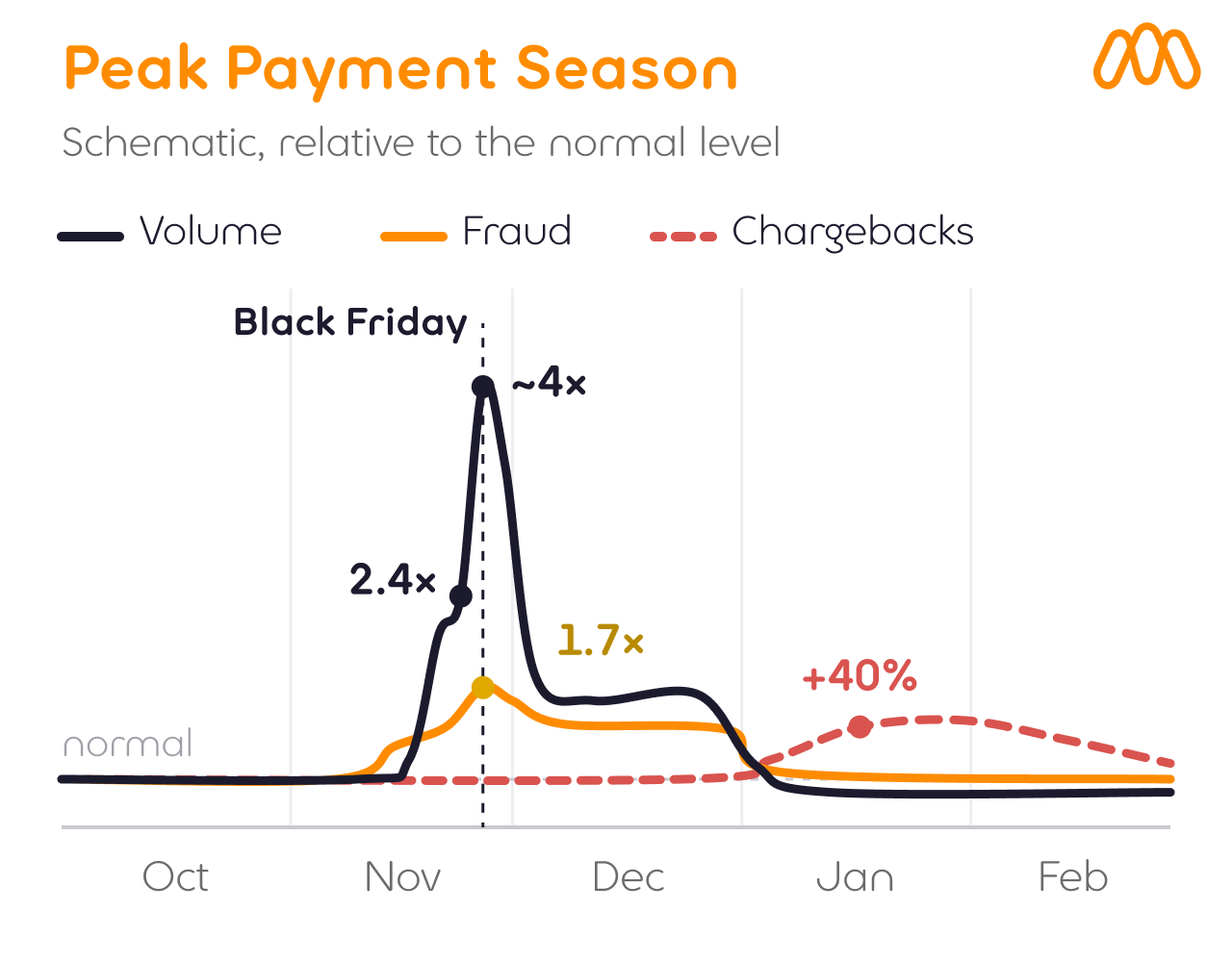
Payment fraud starts rising even earlier. In the same data, the increase is visible as early as November 8, its share during the sales is almost 1.7 times higher than usual, and the elevated level persists throughout December. Why is that? Against the backdrop of overall traffic growth, automated enumeration of stolen cards, known as card testing, is much easier to pass off as normal customer activity, and the more legitimate transactions go through a website, the harder it is to single out suspicious ones. Fraudsters know this, and their activity grows just as much as that of regular customers.
As a result, during this time it is even harder than usual to tell who is who, and payment and fraud prevention settings have a real impact on revenue. At the same time, the period lasts not four days (as is commonly assumed) but six to eight weeks, and it begins long before the holiday banners appear.
Payment Declines That Could Have Never Happened
The main payment loss of peak season is even more often linked not to fraud but to payment declines, that is, cases where issuing bank or merchant’s fraud prevention rejects a customer’s payment.
During the season, issuers’ risk models work under greater strain: a sharp increase in the number of card purchases, unusually large tickets, purchases on websites where the customer has never paid before — regularly all of this looks like a rare exception, but at the end of November it becomes the norm, and risk models respond with caution. This is especially noticeable in cross-border payments: if transaction goes through a foreign acquirer, the issuer checks it more strictly, and for a business with an international audience the share of false declines grows faster during the peak than for a local one.
If the merchant also tightens its own fraud rules at this point, fearing a seasonal rise in fraud, the losses add up: the merchant’s own declines are added to the issuers’ declines, and a significant share of them hit real customers. It is also important to consider how a person behaves after a failed payment. Most customers don’t try again, especially during a sale, when the same discounted product can be found at a competitor or on a marketplace in a couple of minutes, so each such decline usually means not a postponed purchase but one that is lost. After all, many customers are coming for the first time and are not loyal to the brand.
Losses can be mitigated by offering alternative option to pay with another method right away, without leaving the checkout page. A customer whose card didn’t go through is more willing to complete the purchase with a wallet, local payment method or an installment plan, so as not to start checkout all over again. These methods play an increasingly visible role during the season: the share of BNPL in weekend payment volume keeps growing, as does the average ticket. In addition, merchants should utilize cascading and proper routing, which are worth taking care of in advance. If you operate in the international market and understand that your audience can be very diverse, one acquirer will not be enough, and it is cascading that provides a safety net at the moment of the transaction without customer having to re-enter payment details.
Monoup can help you set up cascade logic and connect additional payment systems today through an expedited process, so that you have time to prepare for the holidays and don’t lose profit because of shortcomings in your payment infrastructure.
Refunds, Chargebacks and January Metrics
It’s not explicitly correct to rush to sum up the results as soon as the sales end, because a month or more later an equally important stage begins for payments, one that is often overlooked.
First and foremost, these are refunds, because along with sales growth comes a rise in first-party fraud in the form of abuse: demands for refunds for goods that were supposedly not delivered, returns of items after use, repeated use of promo codes. According to Riskified’s estimate based on data from major retailers, almost a quarter of the amount customers request back is attributable to abuse, with November and December accounting for almost a third of all such requests for the year, and more than half of them carrying over into January. At the same time, tightening refund policies is not always possible, because in many countries they are regulated by law, and failed refunds later turn into chargebacks.
Chargebacks themselves are the main problem in the post-holiday profit count, because they begin arriving in volume 45–60 days after the transaction, that is, in mid-January and February. The standard response window of 20 to 45 days can be shorter depending on the acquirer, and during a period when there are many times more cases, it is deadlines that are missed most often, and a missed deadline means an automatic loss.
January wave of chargebacks has a serious effect on card network monitoring programs, including VAMP, which is based on the ratio of fraud and disputes to the number of transactions per month. In January, sales drop sharply while chargebacks on November and December purchases are only beginning to arrive, so the ratio rises from both sides at once, and merchant with normal figures throughout the year may approach the program threshold precisely in the first months of the new one.
Conclusions
Ultimately, from a payments perspective, peak season can be divided into three basic periods: the early traffic increase in early November, sales themselves, and wave of chargebacks in January and February.
The least noticeable losses occur at the beginning and the end of the period rather than on the peak day itself: false declines do not show up in reports as losses because they simply look like payments that didn’t happen, and January disputes are linked to holiday sales only in hindsight. That is why merchants need to act on both fronts at once: ensure uninterrupted operation of the payment system with an adequate level of fraud prevention, and provide high-quality service to avoid chargebacks and refunds from honest customers.