






Monoup news digest: main updates from fintech industry
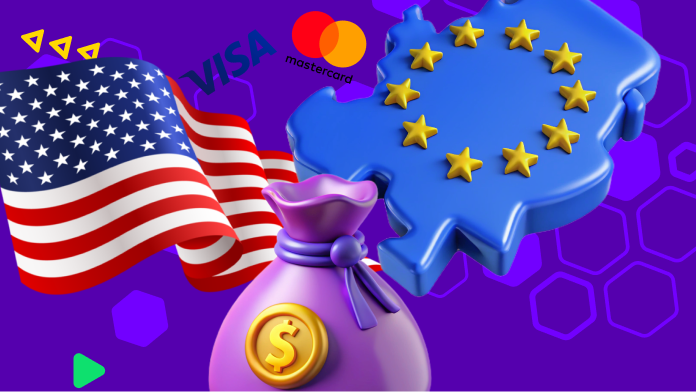
We wrap up the week with important fintech news that is currently impacting online businesses. In Europe, hot discussions around Visa and Mastercard continue, payment systems are becoming more expensive, and current U.S. president's position does not show confidence in stable international cooperation. Europeans are seriously considering alternatives and looking to develop their own card solution. What obstacles have emerged on this path? Let's explore further.
Today's roundup includes everything you might have missed but need to know about fintech and iGaming. We have gathered the key information and present it in a concise and understandable format. Even if you are not a payment expert, you will still understand everything, as our media is created primarily for businesspeople. Enjoy your reading!
T-Bank against online casinos
Popular Russian T-Bank has taken a stand against P2P transactions in favor of illegal online casinos. The current popular way of accepting payments through peer-to-peer transfers across the CIS has been quickly exposed, and bank is warning clients that they may face issues if they participate.
According to local laws, cards of such clients may be blocked, and funds frozen until the source of funds are clarified. The bank may also apply other measures, such as prohibiting certain clients from using international peer-to-peer transfer feature altogether. The news has alarmed many users and iGaming industry, sparking mixed reactions. Some are concerned, while others believe this is old situation and nothing new is happening. Nevertheless, we are keeping a close eye on this and will report updates in our Telegram channel.
Will Visa and Mastercard be replaced in the EU?
In Europe, discussions about finding and alternative to American payment systems Visa and Mastercard have been ongoing for several weeks. The issue is that the share of transactions involving these systems exceeds 50% in e-commerce overall. If we consider only card statistics, the figure is close to 90%.
This indicates a clear dependency of the entire region on the operations and pricing dictated by Visa and Mastercard. Interestingly, this issue is being raised not only in the EU but also in the USA. In both regions, investigations have reached the courts, with governments trying to force payment systems to lower their service fees, but companies are unwilling to comply. Current political situation has further fueled the agitation surrounding this topic, as Trump's tariffs raise concerns about reliability of the "rely on the USA" scheme. European Commission and Central Bank are considering possibility of developing their own payment system.
The idea of Europe regaining control of its market has been discussed before. This includes the development of WERO and active implementation of open banking. These are the main products that could compete with credit cards in Europe today. However, even if these payment methods succeed, it seems that a proprietary card system will still be necessary. Many countries have already taken this approach: Uzbekistan has HUMO and UZ Card, China has Union Pay, Japan has JCB, and many other analogs worldwide. Europe has been slow to act, but seems the time has come.
Another problem has emerged: who will develop such a payment system, and how will it make money? Clearly, this is a serious undertaking that requires significant expertise and investment. Regulatory requirements and government pressure will minimize all profit opportunities, as Europeans want low fees. If Visa and Mastercard can still provide them (even unwillingly) by regulating their fees worldwide, a local system would have to operate under the same conditions in the local market. Additionally, strict AML and financial monitoring policies could become obstacles to rapid development and implementation. It will take years to complete this stage.
It is also important to consider that launching such a product on the market is not as simple as it seems. Not only does it need to be created, but it also needs to be "sold" to users. Clients who are already accustomed to international payment system cards must see some benefit from new European alternative.
Stripe obtains banking license
One of the most popular and in-demand payment systems in the USA, Stripe, has applied for a banking license. The Merchant Acquirer Limited Purpose Bank license, which payment system aims to obtain, will allow it to directly collaborate with Visa and Mastercard without needing a bank intermediary.
In this case, the standard processing scheme — bank acquirer + payment system —will be changed to another — payment system directly works with clients and Visa/Mastercard networks. What does the company gain from this? Here, everything is likely quite prosaic. Stripe will be able to simplify its operations and save on commission fees, as it will no longer need to pay for the bank's services.
At the same time, Stripe does not plan to become a competitor to traditional banks, as it is not interested to provide loans and deposit services. However, optimizing the processing is a priority. Whether the reduction in payment provider's expenses will positively affect prices for merchants is not yet known, but the quality and speed of the service will undoubtedly improve.
PIX to have an instalment feature
Brazilian flagship payment method is evolving again, this time with the goal of replacing payment systems Visa and Mastercard. Not only Europeans are concerned about their market share, but Brazilians have also noticed an increase in credit cards share. On one hand, this is a good sign, as users are accustomed to international payment cultures and benefit from globally recognized payment networks.
However, Brazil sees risks and believes that it needs to control the market. Therefore, PIX will now include an installment feature, which is planned to compete with credit cards. Developers have clarified that functionality will almost replicate what users are accustomed to with actual credit cards, but how this will work considering PIX's specifics remains undisclosed. Most likely, credit funds or an available limit for installment purchases will appear within the system.
Central Bank calculates that Brazilian audience will choose its familiar payment method if there’s a need for credit line, and will not rely on international card brands instead. This, in turn, will help reduce share of cards in the country. Interestingly, in certain online businesses, card usage is indeed very high. For example, online games and character trading services often accept only cards, and Brazilian audience has already adapted.
These are the updates Monoup has gathered for you this week. Remember that you can receive news on Telegram, where we publish all the main events daily as short messages.


