


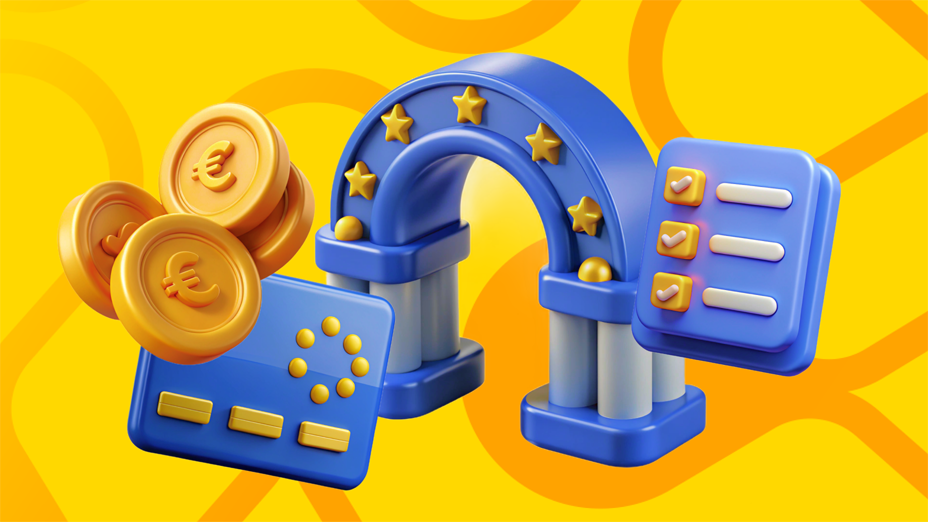




iGaming payments in Europe in detailed review
Europe has long been the number one market for various businesses, as it has stable environment, good financial conditions of population, and high interest in new services. Conquering the European gaming market is no easy task, not only because it is highly competitive and regulated, but also because of market specifics. Despite something is common and EU shares similar trends among countries, many of them pose significant differences. This means that you will need analytics for each country separately.
In payment systems, this works in a similar way: there are pan-European payment methods that work across the entire territory European Union, and local methods operating in one or a few countries. Of course, one can acquire a set of "common" payment methods and try to operate in Europe, but this will not allow for full localization and may lead to profit losses right away. Let's discuss how to avoid this in today's article. European market review by Monoup!
European payment system landscape
When talking about Europe as a financial system, we can say that it is already well-established and considered mature on a global scale. There are several old payment methods that are entrenched in the payment habits of population. This presents both advantages and disadvantages for merchants. A clear payment infrastructure, secure money flows, and stability provide the opportunity to operate at a steady pace and be confident in the future. However, operating in Europe can be challenging due to the large number of regulations and rules governing payment industry. Currently, European Union is taking significant measures to regulate cryptocurrencies, which also affects iGaming merchants and requires rapid adaptation. MiCA has already banned the use of the most popular stablecoin, USDT, and further regulations require full compliance with new rules from other coins. Implementation of instant transactions and open banking also has a significant impact on payment habits in the region. Some banking analysts believe that transactions completed in less than 10 seconds can almost instantly increase payment volumes. However, many European banks have encountered difficulties in implementing these 10-second payments, and it is unclear when they will be fully operational.
Europeans value the convenience payment process and user-friendly interface. Traditional views do not leave room for experiments, so when entering European market, you must be prepared to adapt to users and their established habits. Despite bank transfers forming the basis of regional money flows, Europeans do not choose this payment method for daily expenses. Instead, credit cards, wallets, and instant payments are the foundation of online payment processing in Europe for the gaming business. Let's look at some of them in more detail.
Which payment systems are popular in Europe?
European payment methods are diverse and based on solid banking technologies. Since users seek security, most of them are oriented towards this point.
Among the most popular methods today, open banking is probably the brightest star. It allows for the processing of payments from account to account instantly and without entering payment details. For Europe, bank transfers have always been an integral part of daily routines, but their flow did not match modern pace of life. For many users, it was difficult to remember full bank details like IBAN and make payments in online banking. In this case, automatic filling of all data by open banking technology helps avoid many steps and speeds up the payment.
Payment process looks very simple: client selects desired method in payment window on the merchant's website, enters desired amount, and selects bank where they hold an account. The technology automatically connects to the bank, and at this time, client must log into their online banking using their standard login and password. All actions are protected according to the payment standards of the European Union, and it is impossible to "intercept" payer's actions. Upon logging into their online banking, client will immediately see payment, which only needs to be confirmed. And that's it, funds are instantly debited from the account, and payment is processed instantly.
Thanks to this simplicity, payment method has gained the trust of users and merchants, as it allows for acceptance of payments quickly and without option of chargebacks (as it happens with credit card payments). Thus, both participants in the process are protected and receive quality service.
Cards from payment systems like Visa and Mastercard are also a priority payment method for many Europeans. The majority of population has a bank account and a linked card, uses savings and cashback programs, and wallets like Apple Pay and Google Pay. Paying by card with a few clicks is the most preferred option, which is possible if the merchant has PCI DSS certification. Otherwise, payment details will need to be entered each time, but this is not an issue if the business provides quality service. The downside for merchants can be chargeback procedure, which is often used to request illegitimate refunds: when the service has been received by the client, but they still want a refund. Such fraud is not uncommon in gaming industry, so when accepting card payments, pay attention to anti-fraud measures and filter out such "clients."
PayPal, a product of American tech giant, has also gained popularity in Europe. The convenience of electronic payment wallet has been appreciated by many, as well as its widespread use in merchant stores. At the same time, EU regulatory bodies are not satisfied with this event, and currently, implementing Wero — instant P2P transfers via phone number. Wero will be available for merchants as well, but a bit later. Today, payment method has already been launched in Germany and France and will soon expand further into Western Europe.
In addition to the widely available payment options across the EU, there are strong local methods operating in one country or a few neighboring ones. For example, MBWay and Multibanco in Portugal have become pillars of the payment processing for population. We have already discussed them in more detail in "payment systems" section of Mono Talks, where you can find reviews of other payment methods.
BLIK in Poland is particularly popular because it offers a similar capability to Wero for instant payments. Transfers from account to account within a few seconds constitute the main share of Polish processing, and in 2024, BLIK will expand to other countries — Slovakia and Romania.
How Monoup can help your business
In addition to media support and news resources for fintech, Monoup provides consulting services about payments and payment systems. European Union is one of the strongest regions for our expertise; we provide support in opening a bank IBAN account in the EU, searching for and connecting payment systems, AML and compliance for business, opening legal entities, and obtaining licenses.
With us, you can open a turnkey business, coming only with an idea, and get a ready-made structure that meets your needs. Today's regulatory landscape is only becoming more complex, which means connecting startups to the financial system is increasingly difficult. We offer our expertise in payment system issues and are ready to support various business models on the path to successful payment processing.
If you don't know where to start or have already made some mistakes that you want to fix, text us, and we will take care of your case. Payment strategy is not just words — it is an important element of your business, because often the availability and cost of payment methods may affect entire corporate structure. To avoid overpaying and form an efficient system, you have to know market trends and gain relevant experience, which is exactly what Monoup's competencies are built on. Leave a request in the form below or drop us an email.


